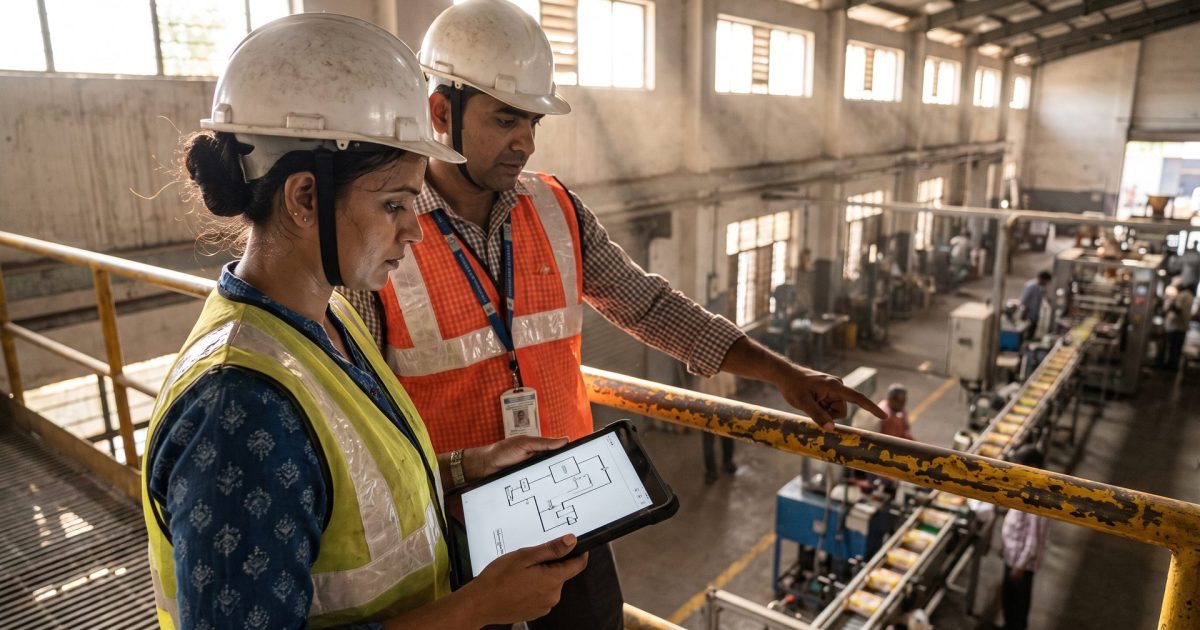

Quick Answer: Two digital twin projects on Indian soil have published results, and neither has published a price. Unilever reports a 30% reduction in quality defects at its Gandhidham plant over four years, and V.O. Chidambaranar Port is targeting up to a 25% cut in vessel turnaround time. Both disclosed the outcome and withheld the cost, which is exactly the gap that stalls approval for everyone else. No benchmark ROI figure exists in rupees, so stop hunting for one. Scope a single asset with a known, measurable loss, cost that pilot properly in rupees, and let the first payback fund the second stage.
Ask a vendor what a digital twin costs and you will get a discovery call. Ask the internet and you will get a range in dollars, drawn from a European automotive plant that shares almost nothing with a mixed-vintage line in Pune or Coimbatore. Meanwhile the board wants a number, and the plant head wants to know which of the eleven things on the shop floor it will actually fix.
This is a working view of what the public Indian evidence supports, where the money genuinely goes, and how to structure a first project so that it either proves itself or dies cheaply.
What the two Indian reference projects actually show
There are not many Indian digital twin deployments with published outcomes. There are two worth studying closely, and the detail matters more than the headline.
Unilever at Gandhidham
In June 2026, Unilever and Accenture reported that the digital twin at Unilever’s Gandhidham site in Gujarat had contributed to a 30% reduction in quality defects, measured over roughly four years. The company said it plans to add more than 40 further twins across its network within 18 months.
Three things in that sentence deserve attention. The measurement window is four years, not four months. The metric is defect rate, not an abstract efficiency score, so it maps to a rupee value the finance team can verify from scrap and rework registers. And the decision to scale to 40 more sites is the strongest signal in the announcement, because a company does not repeat an expensive exercise 40 times on the strength of a slide.
V.O. Chidambaranar Port, Thoothukudi
In early 2026, V.O. Chidambaranar Port launched what was described as India’s first port digital twin, modelling vessel movements, berth allocation and yard operations, with a stated target of reducing vessel turnaround time by up to 25%.
Note the verb. This is a target, not a result. At the time of writing, the port has not published verified post-implementation turnaround data, and the project cost has not been disclosed. Treat it as a live experiment worth watching rather than a proof point to cite in your own business case.
Why nobody will tell you the price in rupees
Search for digital twin costs and the figures you find are almost always in dollars, drawn from Western deployments, and quoted without saying what was included. The currency conversion is the least of the problem. Cost structure genuinely differs in India, and it differs in both directions.
Engineering and integration labour, which is usually the largest line item, costs a fraction of the European equivalent. Platform licences, bought in dollars from the same three or four global vendors, do not. Instrumentation sits in between, depending on how much you import. So an imported benchmark is wrong on every line, and wrong by a different multiple on each one. Averaging it into a single rupee figure produces a number that feels precise and is worthless.
There is a second reason, less often admitted. Most quoted figures cover the software and the modelling, and quietly exclude the two things that actually consume the budget on an Indian brownfield site: getting trustworthy data off machinery of four different vintages, and persuading the people who run that machinery to work from the model instead of around it.
Where the money actually goes
Rather than chase a benchmark, cost your own project across these six heads. Ask any vendor to quote against the same six, and the proposals become comparable for the first time.
- Instrumentation. Sensors on assets that are not currently instrumented, plus the gateways to read older PLCs. On a brownfield Indian line this is usually larger than expected, because equipment bought across two decades speaks several protocols and some of it speaks none.
- Connectivity and edge. Shop-floor networking, edge compute, and the question everyone forgets until commissioning: what the model does during a power event or a link failure.
- Platform licence. Usually annual, usually dollar-denominated, usually priced per asset, per tag or per user. Establish which, because the three scale very differently once you go from one line to the whole plant.
- Integration. Connecting the twin to the systems that already hold your truth: ERP, MES, maintenance and quality records. This is where timelines slip.
- Modelling and validation. Building the model, then proving it predicts reality closely enough to act on. A twin nobody trusts is an expensive dashboard.
- Run cost and ownership. Someone maintains the model as the plant changes, and the plant always changes. Budget the role, not just the software renewal.
Where twins pay back fastest on an Indian shop floor
The pattern across the credible cases is that twins earn their keep where a physical experiment is slow, dangerous or expensive, and a simulated one is none of those. That narrows the field usefully.
- High-value continuous processes in cement, speciality chemicals, steel and pharma, where an unplanned stop costs more per hour than the entire pilot.
- Quality problems with disputed causes, the kind that have survived three root-cause exercises. This is the Gandhidham pattern: a defect rate that refused to move until the interactions became visible.
- Congested logistics, where the constraint is sequencing rather than capacity. Ports, large warehouses and multi-line packing halls qualify.
- Energy-intensive operations, where tariffs vary by time of day and load-shifting has real value.
It is just as useful to name where a twin rarely repays the effort. Short-run job shops with constantly changing products struggle, because the model expires faster than it can be validated. So do plants where the real constraint is upstream supply or labour availability, since no amount of simulation fixes a material that has not arrived. And if the maintenance history lives in a register on someone’s desk, that is the project to fund first.
Scoping a first project that can fail cheaply
The single most useful discipline is to pick the asset whose losses you can already quantify. Not the most strategic asset, and not the newest one. The one where the plant head can tell you, from records rather than memory, what last year’s unplanned downtime or scrap actually cost.
That gives you a denominator. Without it, every ROI conversation for the next two years is an argument about assumptions. With it, the pilot has a pass mark before it starts, and the gate at the end is a matter of arithmetic rather than opinion.
Two further constraints are worth writing into the scope. Set a validation period long enough to cross a real production cycle, including a monsoon month and a festival-season shutdown if those affect your plant, because a model validated only in steady state will mislead you in the month that matters. And name an owner on the plant side, not only in the IT function. Every twin that quietly stops being used lost its plant-side owner first.
Six questions to ask before you sign
- What exactly is priced per asset, per tag and per user, and what does the licence cost at ten times this scope?
- Which of our existing machines can you read without new hardware, and which need gateways? Ask for this as a list against our asset register, not a general assurance.
- Who owns the model after go-live, what does that cost annually, and what happens when we change the line layout?
- Where does the data physically sit, and does that satisfy our obligations under the DPDP Act and any customer contract clauses on data location?
- What does the twin do during a network or power failure, and how does it resynchronise afterwards?
- Can you name an Indian brownfield site where you have done this, and may we speak to their plant head rather than their CIO?
The last one filters hardest. Plenty of vendors have delivered twins for greenfield plants with uniform, modern equipment. Far fewer have made one work across a shed where a 1998 machine sits beside a 2024 one, which is the situation most Indian manufacturers are actually in.
The honest summary
The Indian evidence base for digital twins is thin but improving, and it is more credible than the vendor material because it is specific. A 30% defect reduction over four years at a real plant in Gujarat tells you the mechanism works and the timescale is long. A port targeting 25% faster turnaround tells you the public sector is now willing to fund the experiment.
What neither tells you is what it will cost on your site, and no benchmark will. That number comes from a scoped pilot on an asset whose losses you already know, quoted across the six heads above, with a gate at the end that you have agreed to honour. Build the business case on your own arithmetic and the twin becomes a normal capital decision. Build it on an imported average and it stays a slide deck.
Frequently asked questions
What does a digital twin cost for an Indian manufacturing plant?
No credible public benchmark exists in rupees. The two Indian projects with published outcomes, Unilever’s Gandhidham plant and V.O. Chidambaranar Port, have not disclosed cost. Published dollar figures come from Western deployments where the ratio between engineering labour and software licensing is very different, so converting them produces a misleading number. Cost your own pilot across six heads instead: instrumentation, connectivity and edge, platform licence, integration, modelling and validation, and annual run cost.
How long before a digital twin pays for itself?
Longer than most business cases assume. Unilever’s reported 30% reduction in quality defects at Gandhidham was measured over roughly four years. A tightly scoped single-asset pilot can show a measurable signal within one or two production cycles, but plant-wide returns accumulate over years, not quarters. Set the validation window long enough to include seasonal variation such as a monsoon month or a festival shutdown.
Can a digital twin work on old machinery?
Yes, but the instrumentation cost rises and should be budgeted honestly. Equipment bought across two decades typically uses several communication protocols, and some older machines have no digital output at all, so they need sensors and gateways retrofitted. Ask any vendor to mark up your actual asset register showing which machines they can read as-is and which need new hardware, rather than accepting a general assurance.
Which Indian industries get the most from digital twins?
Those where an unplanned stop is expensive and a physical experiment is slow or risky: cement, speciality chemicals, steel, pharmaceuticals, and congested logistics operations such as ports and large warehouses. Energy-intensive plants facing time-of-day tariffs also benefit from load-shifting. Short-run job shops with frequently changing products gain least, because the model becomes outdated faster than it can be validated.
Is a digital twin the same as a simulation or a dashboard?
No. A simulation is a one-off model used to answer a specific question, and a dashboard reports what already happened. A digital twin stays connected to the live asset, updates as conditions change, and is used to test decisions before they are made on the real equipment. If a proposed system does not receive live data and is not used to make forward decisions, it is a dashboard with a more expensive name.
What is the most common reason digital twin projects fail in India?
Loss of plant-side ownership. Projects that are run entirely from the IT function tend to produce a technically correct model that operators work around rather than from. The second most common cause is starting on an asset whose losses were never quantified, which leaves the project with no agreed pass mark and turns every review into an argument about assumptions.
WinInfoSoft is ISO 9001:2015 and ISO 27001 certified and assessed at CMMI Level 3, and works with manufacturing and logistics businesses on industrial data, integration and AI projects. If you are weighing a first digital twin pilot and want the scoping questions pressure-tested before a vendor conversation, get in touch.


