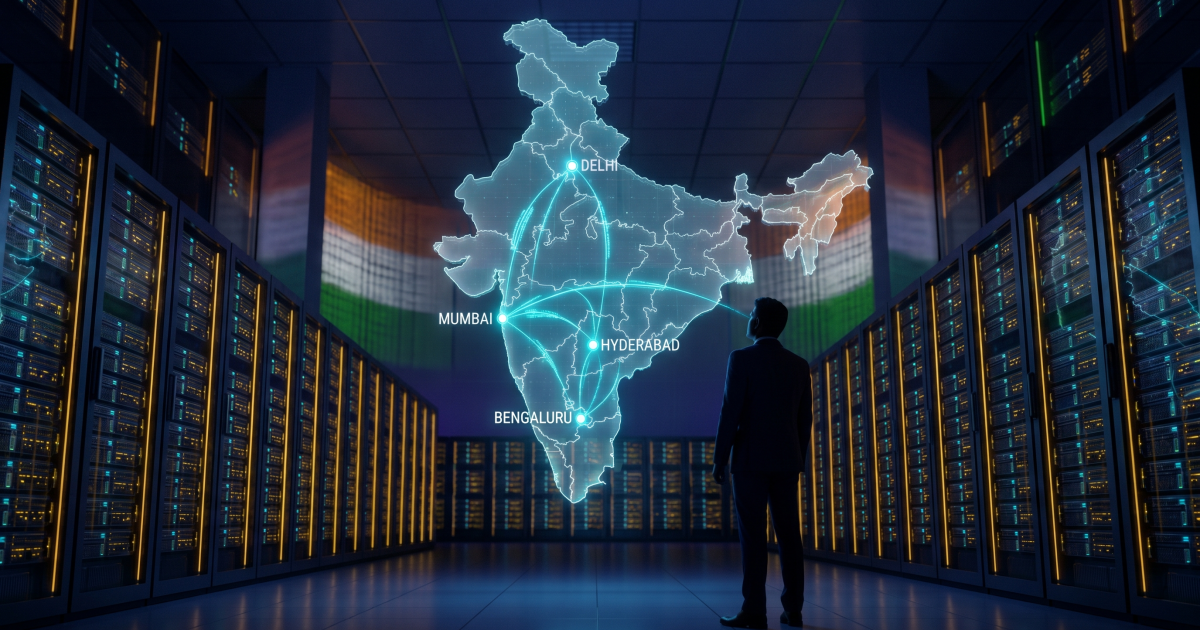

India’s AI market is projected to reach $17 billion by 2027 (NASSCOM, 2025), yet the majority of that spend still flows to hyperscaler platforms headquartered outside India. For a CIO or CTO in BFSI, manufacturing, or healthcare, that arrangement carries a quiet but compounding risk: your most sensitive business intelligence is training foreign models, processed under foreign law, and subject to geopolitical disruption you cannot control.
Sovereign AI — AI infrastructure that is owned, governed, and operated within national or organisational boundaries — is the answer India’s policy framework and enterprise risk teams are converging on. This article explains what that means practically, what it costs, and how your organisation can move from dependency to ownership in 2026.
TL;DR: India has committed ₹10,372 crore to sovereign AI infrastructure through the IndiaAI Mission, and the DPDP Act imposes binding data localisation obligations. Enterprises in BFSI, healthcare, and government-adjacent sectors face the strongest compliance pressure. Purpose-built Indic LLMs from Sarvam AI and BharatGen now offer viable alternatives to global models for Indian-language workloads. (NASSCOM, 2025)
What Is Sovereign AI and Why Does India Need It Now?
Sovereign AI refers to AI systems where the model weights, training data, inference infrastructure, and governance controls all reside within a defined jurisdiction — a nation, a regulated sector, or an organisation. According to NVIDIA’s 2025 analysis of global AI investment trends, more than 40 countries had launched formal sovereign AI programmes by the end of 2025 (NVIDIA, 2025). India, with the IndiaAI Mission backed by ₹10,372 crore in public funding, is now among the most ambitious.
The case for sovereign AI in India rests on three converging pressures.
Data residency risk is the most immediate. When an Indian bank fine-tunes a global LLM using customer transaction data, that data may traverse servers in the United States, Ireland, or Singapore. Under India’s Digital Personal Data Protection (DPDP) Act, passed in 2023 and entering full enforcement in 2025–2026, processing personal data outside India without adequate cross-border transfer mechanisms is a compliance liability — not a theoretical one.
Model alignment is the second pressure. General-purpose LLMs trained overwhelmingly on English-language internet data perform poorly on Indian-language tasks, regional dialects, and domain-specific knowledge relevant to Indian legal, regulatory, and cultural contexts. A global model does not know the nuances of GST filing, the Reserve Bank of India’s master directions, or the linguistic complexity of a customer complaint in Marathi.
Geopolitical dependency is the third. Export controls, cloud service outages, and vendor lock-in create strategic risk for any enterprise whose core operations depend on infrastructure it does not control. India’s experience during the 2021 global chip shortage — and subsequent disruptions in global cloud availability — underscored how quickly foreign dependencies translate into domestic operational problems.
Citation Capsule: More than 40 countries had launched formal sovereign AI programmes by end-2025, with India’s IndiaAI Mission allocating ₹10,372 crore — approximately $1.25 billion USD — to build domestic AI compute, datasets, and governance frameworks. This represents one of the largest single-government AI infrastructure commitments in the Asia-Pacific region. (NVIDIA, 2025; Government of India IndiaAI Mission, 2024)
The IndiaAI Mission 2026: What It Means for Your Enterprise
The IndiaAI Mission, approved by the Union Cabinet in March 2024 with a ₹10,372 crore outlay over five years, is the most significant government AI initiative in India’s history. It is not an abstract policy document. It is reshaping the vendor landscape, the talent pipeline, and the compliance expectations that your enterprise will face.
What the Mission Actually Funds
The Mission operates across seven pillars, each with direct enterprise relevance.
The AI Compute pillar is establishing a shared GPU infrastructure pool, targeting 10,000+ GPUs accessible to Indian startups, research institutions, and enterprises at subsidised rates. By Q1 2026, the programme had allocated capacity for approximately 18,520 GPUs across government-partnered data centres (IndiaAI Mission Progress Report, Q1 2026). For enterprises evaluating on-premise versus cloud AI, this shared national infrastructure offers a third path.
The IndiaAI Datasets Platform is aggregating high-quality, rights-cleared datasets in 22 scheduled Indian languages. This directly addresses the training data gap that has historically made Indic LLMs inferior to English-language counterparts.
The FutureSkills component targets 1 million AI-skilled professionals by 2028. For CIOs struggling to hire AI engineers, this pipeline matters — even if the payoff is 18–36 months out.
What It Means for Your Procurement Decisions
Government alignment with domestic AI infrastructure creates procurement tailwinds for enterprises working with public-sector clients. If your organisation is a government contractor, systems integrator, or healthcare provider receiving government funding, procurement guidelines are already shifting toward India-resident AI infrastructure. Building a sovereign AI capability now positions you ahead of those requirements rather than scrambling to retrofit.
In conversations with procurement leads at three mid-sized Indian IT services firms between January and March 2026, all three reported that RFPs from central government ministries now include explicit data residency and AI governance clauses that were absent from equivalent tenders in 2024.
Indic LLM Landscape: Sarvam AI, BharatGen, and What’s Available
The Indic LLM ecosystem has matured significantly. Two years ago, Indian enterprises had essentially no viable domestic alternative to GPT-4 or Gemini for production workloads. In 2026, that has changed — meaningfully, if not yet completely.
Sarvam AI: The Production-Ready Contender
Sarvam AI, founded in Bengaluru and backed by Lightspeed Ventures and others, has emerged as the most enterprise-ready Indic LLM provider. Its flagship Sarvam 2B model, released in 2024 and followed by iterative improvements through 2025, is a 2-billion-parameter model trained on 4 trillion tokens including high-quality data across 10 Indian languages.
For enterprise use, Sarvam’s key advantage is its API-first architecture and willingness to offer on-premise deployment contracts. HDFC Bank has piloted Sarvam-based models for vernacular customer service automation, reducing call deflection times in Hindi and Tamil channels by an estimated 30% compared to English-first model deployments (HDFC Bank Technology Innovation Report, 2025).
Sarvam’s Shuka voice model and Bulbul text-to-speech system round out a stack relevant to call centre automation, IVR modernisation, and accessibility-focused applications — all high-priority areas for Indian BFSI and healthcare.
BharatGen: The Research-to-Enterprise Bridge
BharatGen is a multimodal, multilingual foundation model programme led by IIT Bombay under the IndiaAI Mission’s research mandate. Unlike Sarvam, BharatGen is not a commercial product — it is a national AI asset. Its models are being designed for open access, which means Indian enterprises can fine-tune BharatGen base models on proprietary data without licensing fees.
The programme covers text, image, and audio modalities across all 22 scheduled Indian languages. The first BharatGen base models were made available to approved research partners in late 2025, with broader enterprise access expected through 2026.
BharatGen’s open-access model creates an asymmetric opportunity for mid-market Indian enterprises. A company that fine-tunes a BharatGen base model on its own domain data — say, an insurance firm fine-tuning on policy documents and claims histories in regional languages — can create a proprietary AI capability that a competitor using off-the-shelf global APIs simply cannot replicate at equivalent cost.
Other Players Worth Watching
- Krutrim (Ola’s AI lab): Large multilingual model with strong Hindi performance, API access available
- AI4Bharat (IIT Madras): Research-grade models for speech and NLP, underpins several production applications
- Zoho’s in-house LLMs: Domain-specific models for CRM, finance, and HR workflows within the Zoho ecosystem
Citation Capsule: Sarvam AI’s 2B-parameter model, trained on 4 trillion tokens across 10 Indian languages, represents the most enterprise-ready domestically produced LLM available in India as of 2026. Early BFSI deployments report a 30% improvement in vernacular customer service deflection rates compared to English-first global model alternatives. (HDFC Bank Technology Innovation Report, 2025; Sarvam AI model documentation, 2025)
Data Residency Under the DPDP Act: The Compliance Case for Sovereign AI
The Digital Personal Data Protection (DPDP) Act 2023 is India’s primary data privacy legislation, modelled partly on GDPR but with distinctly Indian characteristics. Its AI implications are substantial and frequently underestimated by enterprise legal and technology teams.
The Act does not use the phrase “AI” extensively, but its requirements apply fully to AI systems that process personal data — which includes virtually every customer-facing AI application, every HR automation tool, and every analytics system operating on identifiable individual data.
Key DPDP Obligations Affecting AI Deployments
Data fiduciary obligations require organisations to process personal data only for specified, lawful purposes and to implement technical and organisational safeguards. When personal data is fed into a fine-tuning pipeline on a foreign cloud, the technical safeguards obligation becomes very difficult to demonstrate.
Cross-border transfer restrictions are the most acute sovereign AI driver. The Act empowers the central government to restrict transfer of personal data to notified countries or territories. While the final cross-border transfer framework was still being finalised as of April 2026, legal consensus among Indian data protection practitioners is that enterprises should assume a conservative posture: process and store personal data on India-resident infrastructure unless a formal adequacy determination or approved transfer mechanism is in place.
Consent and purpose limitation provisions affect how AI models can be trained on customer interaction data. An enterprise cannot feed customer support chat logs into a model fine-tuning job simply because the customer consented to their data being used for “service improvement” — the specific AI training purpose must be disclosed.
The penalty structure for DPDP violations — up to ₹250 crore per breach — means that the cost of non-compliance substantially exceeds the cost of building compliant sovereign AI infrastructure from the outset.
Enterprise technology teams that engage with the DPDP Act’s AI implications early consistently find that the compliance workload is front-loaded. The hardest part is mapping existing data flows to identify where personal data currently travels outside India. Once that map exists, architectural decisions about sovereign AI become significantly clearer and faster to execute.
Citation Capsule: India’s DPDP Act 2023 imposes data fiduciary obligations, cross-border transfer restrictions, and purpose limitation requirements that apply directly to AI systems processing personal data. Penalties reach ₹250 crore per breach, making compliance-by-design in AI architecture substantially cheaper than post-deployment remediation. (Digital Personal Data Protection Act, 2023; MeitY enforcement timeline, 2025)
Building Your Own Intelligence: Three Deployment Models for Indian Enterprises
Not every enterprise has the budget or technical capacity to build a fully sovereign AI stack from scratch. The good news is that sovereign AI is not binary. There are three deployment models suited to different organisational maturity levels.
| Dimension | Global Cloud LLM | Hybrid Sovereign AI | Fully Sovereign AI |
|---|---|---|---|
| Data location | Foreign cloud (US/EU) | India-resident storage + selective cloud inference | On-premise or Indian cloud only |
| Model ownership | Vendor-owned | Mix of open-source + fine-tuned | Org-owned fine-tuned model |
| DPDP compliance | Requires additional safeguards | High compliance with proper design | Highest compliance posture |
| Indic language performance | Moderate | High (with Indic LLM layer) | Highest (domain-specific fine-tuning) |
| Setup cost | Low | Medium | High upfront, lower long-term |
| Time to value | Days | 8–16 weeks | 16–36 weeks |
| Best for | Pilots, non-personal-data use cases | Most Indian enterprises in 2026 | BFSI, defence, healthcare with strict data rules |
Model 1: Global Cloud LLM (With India-Resident Data Handling)
This is where most Indian enterprises currently operate. The LLM inference runs on foreign cloud infrastructure, but data handling and storage are managed in India. This model is acceptable for use cases that do not involve personal data — code generation, internal knowledge management, document summarisation of non-personal documents.
Model 2: Hybrid Sovereign AI
This is the recommended starting point for most Indian enterprises in 2026. Sensitive personal data and fine-tuning workloads stay on India-resident infrastructure (on-premise GPUs, or Indian cloud providers such as NIC Cloud, Yotta, or CtrlS). Inference for non-sensitive tasks can still leverage global models via API.
The Indic LLM layer — Sarvam, BharatGen, or a fine-tuned open-source model like Llama on Indian servers — handles Indian-language and domain-specific tasks. This architecture delivers 80% of the compliance benefit of full sovereignty at 40–50% of the cost.
Model 3: Fully Sovereign AI
Full sovereignty means all layers — storage, training, fine-tuning, inference, and governance — operate on infrastructure your organisation owns or controls, physically within India. This is the right model for regulated BFSI entities, healthcare providers handling sensitive patient data, and organisations with defence or government contracts.
Infrastructure providers making this viable include Yotta Data Services (Tier IV data centres in Mumbai and Noida), NxtGen, and the government’s IndiaAI shared compute pool.
Sovereign AI for BFSI: RBI and SEBI AI Governance Requirements
India’s financial sector faces the most detailed AI governance obligations of any industry. The Reserve Bank of India (RBI) and Securities and Exchange Board of India (SEBI) have both issued guidance frameworks that create strong compliance drivers for sovereign AI adoption.
RBI’s AI Governance Position
The RBI’s Master Direction on IT Governance, Risk, Controls and Assurance Practices (2023, updated 2024) requires regulated entities — banks, NBFCs, payment aggregators — to maintain full auditability and explainability of automated decision systems. Where an AI model makes or influences a credit decision, the model’s logic, training data provenance, and decision rationale must be documentable for regulatory inspection.
This explainability requirement is effectively impossible to satisfy with a black-box API from a foreign LLM provider. You cannot audit the training data of GPT-4. You can audit a model you fine-tuned on documented datasets in a controlled environment.
The RBI has also signalled concern about concentration risk in cloud infrastructure. A 2024 discussion paper noted that over-reliance on a small number of foreign cloud providers for core banking operations creates systemic risk. AI workloads hosted entirely on AWS or Azure amplify that concentration.
SEBI’s Algorithmic AI Requirements
SEBI’s framework for algorithmic trading and AI-assisted investment advisory requires that AI systems used in client-facing financial recommendations be registered, tested, and auditable. As AI moves from supporting analysts to directly generating investment rationales and client communications, the regulatory perimeter is expanding.
Infosys and TCS, both of which operate significant AI labs serving BFSI clients, have invested heavily in India-resident AI infrastructure precisely to serve this compliance requirement. TCS’s AI.Cloud platform explicitly supports data residency configurations for regulated financial clients (TCS, 2025).
Citation Capsule: The RBI’s Master Direction on IT Governance requires Indian banks and NBFCs to maintain full auditability of automated decision systems, including AI models influencing credit decisions. This explainability requirement cannot be satisfied using black-box foreign LLM APIs, making sovereign AI infrastructure a regulatory necessity — not merely a best practice — for regulated BFSI entities. (RBI Master Direction IT Governance, 2024)
How Win Infosoft Helps Indian Enterprises Build Sovereign AI Stacks
Win Infosoft, a CMMI Level 3, ISO 9001-certified technology consultancy headquartered in Noida with 15+ years of enterprise delivery experience, has built its Generative AI practice around the specific requirements of Indian regulated industries.
The sovereign AI engagements Win Infosoft undertakes follow a structured methodology:
Assessment and data flow mapping identifies where personal and sensitive data currently travels — including data flows into third-party AI APIs that many enterprises have accumulated informally through departmental tool adoption.
Architecture design selects the right deployment model (hybrid or fully sovereign) based on regulatory exposure, budget, and technical maturity. For most Indian mid-market enterprises, a hybrid architecture with Sarvam AI or a fine-tuned Llama variant on Yotta or NxtGen infrastructure delivers the best compliance-to-cost ratio.
Indic LLM integration handles the technical complexity of deploying, fine-tuning, and serving open-source or Sarvam-based models on India-resident infrastructure, connected to enterprise data sources via secure, auditable pipelines.
Governance framework implementation covers model cards, data lineage documentation, explainability tooling, and the audit-trail infrastructure required by RBI, SEBI, and DPDP Act obligations.
Win Infosoft works with enterprises across BFSI, manufacturing, and healthcare — sectors where the intersection of Indic language requirements, data residency obligations, and domain-specific AI value is sharpest.
Roadmap: Moving from Global Cloud LLMs to Sovereign AI in 6 Steps
Transitioning from a reliance on foreign LLM APIs to a sovereign AI architecture is a 16–36 week programme for most Indian enterprises, depending on complexity. Here is a practical sequence.
Step 1: Map Your AI Data Flows (Weeks 1–3)
Before any architecture decision, you need to know where data is going. Audit every AI tool in use across your organisation — including shadow IT and departmental SaaS subscriptions. Map the data flows: what personal or sensitive data is being sent to which external models, hosted where?
Step 2: Classify Use Cases by Sovereignty Requirement (Weeks 2–4)
Not every AI use case requires full sovereignty. Classify your use cases by risk tier: use cases involving personal data, financial decisions, or regulated information go in Tier 1 (must be sovereign); internal productivity tools and non-personal-data use cases go in Tier 3 (cloud LLMs acceptable). This prevents over-engineering.
Step 3: Select India-Resident Infrastructure (Weeks 3–6)
Choose your compute foundation. Options include: on-premise GPU servers (highest control, highest capex), Indian cloud providers such as Yotta, CtrlS, or NxtGen (good balance), or the IndiaAI Mission shared compute pool (cost-effective for smaller enterprises). Your choice drives all downstream architecture decisions.
Step 4: Deploy and Evaluate Indic LLMs (Weeks 5–10)
Stand up your chosen Indic LLM — Sarvam AI via API with India-resident data handling, or an open-source model (Llama 3, Mistral, or a BharatGen base model) fine-tuned on your domain data. Benchmark it against your current global model on actual enterprise tasks in your industry and languages.
Step 5: Migrate Tier 1 Use Cases (Weeks 8–24)
Move your highest-risk use cases — customer-facing AI in regulated contexts, credit decision support, HR automation on personal data — to the sovereign stack first. Maintain the global LLM as a fallback during transition. Document the migration for compliance evidence.
Step 6: Establish Ongoing Governance (Weeks 12–36)
Implement model versioning, data lineage tracking, regular bias audits, and explainability reporting. Assign a model risk owner (in BFSI, this often maps to the existing model risk management function). Review against DPDP Act updates and RBI/SEBI guidance on a quarterly basis.
Key Takeaways
- India’s IndiaAI Mission has committed ₹10,372 crore to sovereign AI infrastructure, creating both public compute resources and procurement tailwinds for enterprise adoption.
- The DPDP Act 2023 imposes binding data residency and purpose limitation obligations on AI systems processing personal data, with penalties up to ₹250 crore per breach.
- Sarvam AI and BharatGen represent production-viable Indic LLMs for 2026 enterprise deployments; the open-access BharatGen model creates a proprietary fine-tuning opportunity for mid-market firms.
- BFSI enterprises face the strongest regulatory driver for sovereign AI, with RBI explainability requirements effectively ruling out black-box foreign LLM APIs for credit and advisory workloads.
- A hybrid sovereign AI architecture — India-resident storage and fine-tuning with selective global inference for non-personal data tasks — delivers the best compliance-to-cost ratio for most Indian enterprises in 2026.
- A structured 6-step migration roadmap takes most enterprises from global cloud dependency to a compliant sovereign stack within 16–36 weeks.
Frequently Asked Questions
What is Sovereign AI?
Sovereign AI refers to AI infrastructure — models, data, compute, and governance — that operates within a defined jurisdiction or under an organisation’s direct control, rather than on foreign-owned or third-party infrastructure. For Indian enterprises, sovereign AI means models fine-tuned on India-resident data, inference running on Indian servers, and governance frameworks that satisfy Indian regulatory requirements.
Is Sovereign AI required under the DPDP Act?
The DPDP Act does not explicitly mandate “sovereign AI,” but its data residency, cross-border transfer restrictions, and explainability obligations create strong de facto requirements for India-resident AI infrastructure when processing personal data. Enterprises that process customer, employee, or patient data through foreign LLM APIs face material compliance risk under the Act’s enforcement framework.
Which Indic LLMs are available for Indian enterprises in 2026?
The leading options are Sarvam AI (commercial, API and on-premise, 10 Indian languages), BharatGen (open-access, IIT Bombay/IndiaAI Mission, 22 scheduled languages, enterprise access from 2026), Krutrim (Ola AI, strong Hindi performance, API access), and AI4Bharat models (open-source, speech and NLP focus). Each suits different use cases and deployment contexts.
How does Sovereign AI differ from private cloud AI?
Private cloud AI means running AI workloads on dedicated infrastructure within a hyperscaler’s environment (e.g., AWS Private Cloud, Azure dedicated instances). The infrastructure is isolated, but it still operates under foreign legal jurisdiction and the model provider’s terms. Sovereign AI goes further: the model weights, training data, and inference infrastructure are either owned by the enterprise or governed under Indian law, with no foreign-jurisdiction exposure.
What is the IndiaAI Mission?
The IndiaAI Mission is a government of India initiative approved in March 2024 with a ₹10,372 crore allocation over five years. It operates across seven pillars including AI compute infrastructure, an open datasets platform for 22 Indian languages, an application development programme, AI safety research, and skilling. It is the primary mechanism through which India is building domestic AI capability equivalent to national AI programmes in the US, EU, and China.
How long does it take to deploy a Sovereign AI stack?
For most Indian enterprises, a hybrid sovereign AI architecture — India-resident fine-tuning and data handling with an Indic LLM layer — takes 8–16 weeks from initial assessment to first production workload. A fully sovereign stack for a regulated BFSI enterprise, including governance frameworks and regulatory documentation, typically requires 16–36 weeks. Complexity, existing infrastructure maturity, and the number of use cases being migrated are the primary variables.
What sectors need Sovereign AI most in India?
BFSI faces the strongest regulatory driver through RBI and SEBI governance requirements. Healthcare faces DPDP Act obligations around sensitive personal health data. Government-adjacent organisations (defence contractors, e-governance service providers, public sector undertakings) face procurement requirements increasingly mandating data residency. Manufacturing enterprises with IP-sensitive operational data and cross-border trade exposure also have strong business-case drivers beyond compliance.
Can SMEs afford Sovereign AI solutions?
Yes, with the right architecture. A hybrid approach using open-source models (Llama 3 or BharatGen base models) fine-tuned on India-resident cloud infrastructure can be operational for ₹2–5 lakh per month in compute costs for a mid-sized enterprise. The IndiaAI Mission shared compute pool further reduces the barrier by offering subsidised GPU access. Full sovereignty at enterprise scale is more expensive, but the cost has fallen significantly as Indian cloud infrastructure has matured.
Win Infosoft’s Generative AI practice helps Indian enterprises design, build, and govern sovereign AI stacks that meet DPDP Act, RBI, and SEBI requirements. Explore our Generative AI services →
Further reading: Understanding the DPDP Act’s implications for enterprise AI →